
What is a Business Architect?
And why you might need one
If you search for the definition of a Business Architect, you’ll usually find something like this:
“A Business Architect defines enterprise capability models, value streams and organisational design to align strategic objectives with operational execution.”
Which is exactly the sort of thing that would make most people immediately lose interest.
So let’s say it clearly.
There comes a stage in most businesses where growth stops feeling great and just feels like stress. Revenue is up. Opportunities are everywhere. The world could be your oyster.
From the outside, the business looks incredibly successful. But on the inside, you’re feeling the pressure.
You’re involved in absolutely everything. Decisions never stop. Your day is a constant stream of questions, interruptions and things that somehow keep landing back on your desk.
You’re working morning, noon and night. It’s a shame, you love what you’ve built but it doesn’t feel stable. It feels like you’re constantly standing on slightly rocky ground.
This usually happens for one simple reason. The business has grown faster than the structure behind it.
Most businesses are not designed from the outset. They evolve around the person running them. In the early days decisions are made quickly. Responsibilities overlap. Systems are informal and a lot of important knowledge lives in your head.
That’s fine at the start. Speed matters more than structure and systems in the early stages. Then the business grows and those same habits that created speed, start to create friction.
What once made the business flexible and fast slowly becomes the thing that makes it harder to run.
So now the business you built is all consuming. Everything is on you, which would be fine if you didn’t already have a million things to do. Instead, you’ve hit a wall.
This is where my work, the work of a Business Architect, begins.
A Business Architect looks at how the company actually functions, not just how it looks on paper.
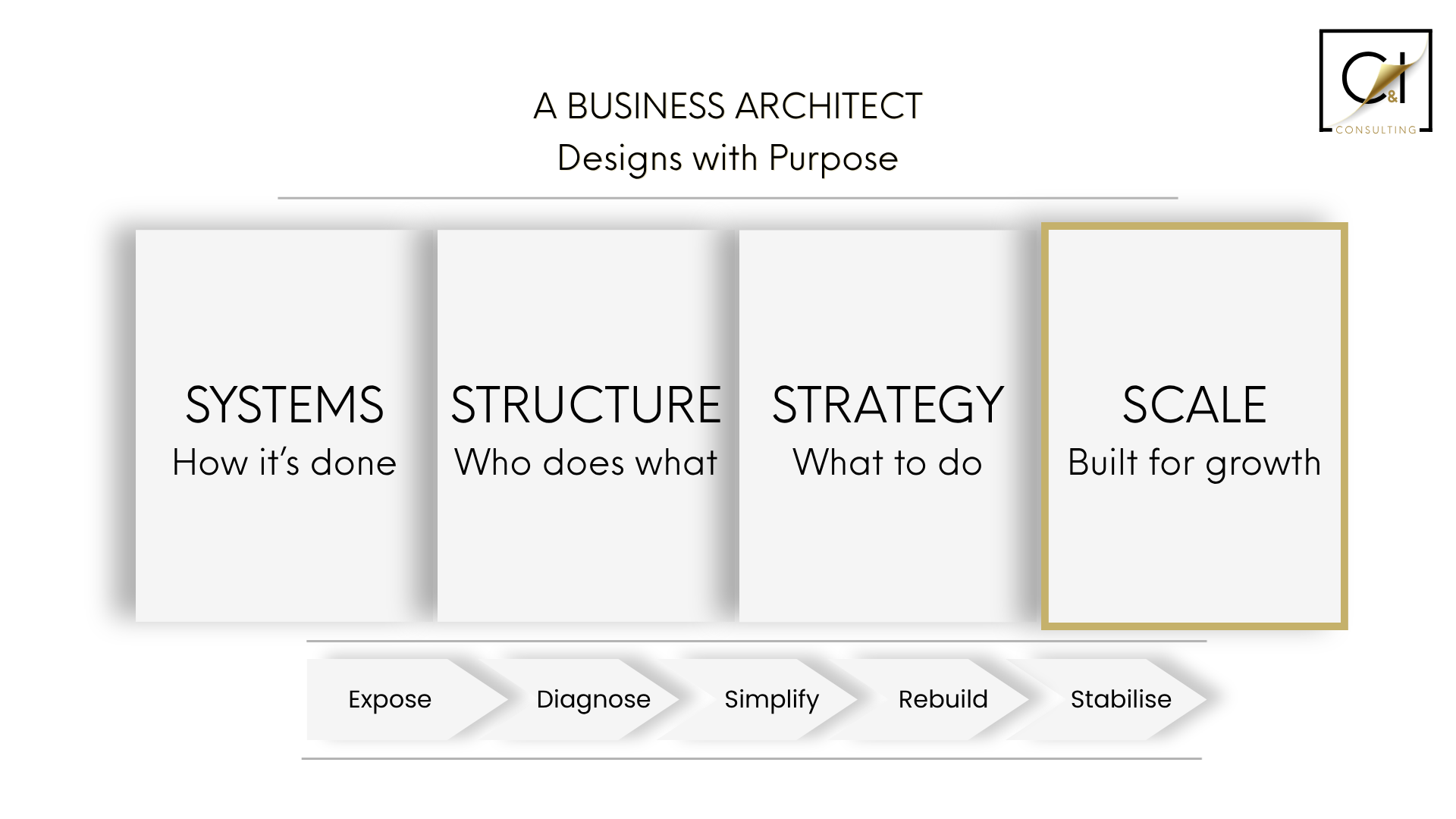
First things first, expose and diagnose.
I start by looking at what is really happening inside the business day to day. Who is making the decisions? How are decisions made? What is actually being done?
Once that is understood, the structure of the business can be redesigned. This is where we simplify and rebuild.
This usually involves three areas.
Designing the operational systems that allow the company to run smoothly without constant supervision.
Then building the structure by defining ownership, accountability and decision rights so work does not constantly end up back on your desk.
And finally, creating a strategy that clarifies the direction and priorities so effort is focused on what actually matters.
After that, something important happens.
Your headspace returns, everyone knows what they are doing and the business starts to run like clockwork. You now have a well-oiled machine.
Things stabilise.
Now you can grow properly, because growth no longer creates chaos and the structure supporting the business evolves with it.
You now have a business that has been designed with purpose and built for growth.
